ARRIVE WITH CONTEXT
Bring one real operating question
Start with a high-level operating question, not a pitch. It gives other founders a useful way into the conversation without exposing confidential company information.
Learn to lead with AI, decide what to build, and reuse what works. FinoraAI is building a founder working network: peer circles, a practical Academy, an operating-pattern library, and company labs for founders who want more leverage without losing judgment or control. Availability and terms are confirmed before any enrollment or engagement.

FinoraAI Club is not a course with a networking break. It is a working network for founders. Each proposed circle begins with a real operating question, helps people facing adjacent decisions exchange high-level perspectives, and returns to the work with a clearer next step. Share only what is appropriate for a learning setting; confidential company information stays out of the room.
Start with a high-level operating question, not a pitch. It gives other founders a useful way into the conversation without exposing confidential company information.
The peer connection begins with shared operating reality: a broken handoff, an unreliable queue, a slow cash signal, or a control concern. Compare approaches, assumptions, and decision boundaries.
A circle may end with an operating artifact, a clearer decision, or a permission-based follow-up with another founder. Follow-up belongs to the people involved; it is never required.
The Club gives founders a working network around honest operating questions. Academy teaches the managerial skill. Library makes original, safe patterns reusable. Company Lab turns the right decision into a controlled test.
Bring a live operating question, not a slide deck or generic prompt. Participants choose what is safe to share, keep confidential business data out, and continue any peer follow-up only by mutual choice.
Learn how to choose useful work, set a task with context and evidence, keep a human decision boundary, and test AI against the exceptions that matter.
The planned subscription layer is designed around original task briefs, control maps, prompt recipes, and red-team tests. No founder’s confidential company data belongs in the library.
A fit conversation can determine whether a narrow company lab should be scoped with a named owner, human approval boundary, evidence trail, and review gate.
Every session should create one useful operating asset: a decision memo, workflow map, control boundary, test record, or next-step brief. If it does not change a founder’s next decision, it does not belong in the room.
FinoraAI Club is the proposed entry point to a working founder network. Every proposed circle is designed around one real operating question, purposeful peer connection, and a practical artifact. The proposed format is a FinoraAI metaverse learning space. Access details and registration status are confirmed before a session is treated as scheduled.
Build a fictional prototype in a FinoraAI metaverse workshop: permitted AR-data intake, required-field validation, a reviewer-owned overdue and dispute queue, human-approved reminder and call preparation, and human-only credit-limit decisions.
Capture, validate, match, code, route, and retain invoice evidence while a human keeps payment authority.
Design vendor checks, approval routing, payment-batch preparation, release controls, and payment evidence.
Turn bank, card, and operating-system activity into controlled postings and a short exception queue.
Build a request-to-PO workflow with quote comparison, approval, receiving, and invoice matching.
Connect customer requests, job completion, invoicing, statements, disputes, reminders, and collection handoffs.
Review evidence from member pilots and turn the best next workflows into a controlled implementation backlog.
Schedule source: 04_Source_Data/club_schedule.json;
scope: organizer-proposed Central Indiana club calendar;
computation: direct event transcription plus current organizer
delivery-format direction. Metaverse access details and
registration remain unconfirmed.
This is not a prompt course. Accelerate Your Business with AI is FinoraAI’s independent course for founders who need to choose the right work, frame a reliable task, use AI with judgment, and make the result safe enough to test in a company. It complements peer exchange without requiring confidential company information.


Define the operating decision, its owner, current friction, required evidence, and what AI should prepare, not decide.
Give AI the business context, source evidence, rules, examples, output format, review step, and a clear stop condition.
Test incomplete information, unusual cases, and incorrect inputs. Record what passed, what failed, and when a person must decide, approve, or escalate.
Practical idea: let an AI workflow organize permitted, fictional cash-planning inputs into a review queue, while named people validate sources, approve assumptions, and make every banking or payment decision. The goal is not an automated forecast. It is a reviewable list of what is known, missing, late, or inconsistent before an owner uses it for planning.
An owner-led service business can use an invented receivables list, approved payroll calendar, and mock supplier commitments to prepare a planning queue. The workflow groups expected inflows and outflows, identifies a missing due date, a duplicate commitment, or an unsupported timing assumption. The owner decides what to clarify, defer, or include in the plan.
Using invented names and sample records only, choose one planning horizon. State the permitted input categories, source owner for each category, missing or conflicting-input triggers, reviewer, and escalation route. Do not paste real bank, payment, payroll, vendor, client, employee, credential, or production information.
A named planning owner, a source and freshness check for each input, a clear no-action condition, a field-level source reference, and an escalation route for missing or conflicting assumptions. FinoraAI reviews structure and control logic, not professional compliance or accounting advice.
The listed sessions are proposed. Submit an interest request for a topic and say whether you are looking for a working circle, peer connection, or both. A place exists only after FinoraAI confirms the date, time, time zone, metaverse access details, and registration status.
Software is not the first decision. The first decision is whether the process is worth fixing, whether the business has usable evidence, and whether management is prepared to change ownership and approvals.
Collect the documents, handoffs, system screens, approval paths, exceptions, and workarounds that define the current process.
Set the unit cost, volume, turnaround time, error burden, cash impact, and control requirements before design begins.
Agents prepare, compare, classify, route, and follow up. Authorized people retain material decisions and approvals.
Run a signed result bridge from the baseline to the post-launch outcome, including operating cost and normalization.
FinoraAI turns founder decisions into buildable operating systems. The studio combines finance-operations depth, agent design, and human control boundaries around the systems a company already has. Authorized people retain vendor, payment, and material decisions.
Invoice capture, validation, coding, matching, approval routing, vendor checks, and approved payment-batch preparation.
Discuss this workflow →Transaction posting, bank and card reconciliation, evidence, exception queues, and close support.
Discuss this workflow →Purchase requests, quote comparison, vendor onboarding, customer requests, billing, receivables, and collections.
Discuss this workflow →These are FinoraAI design patterns, not autonomous agents offered as a black box. Every pattern begins with a business question, permitted inputs, required evidence, a human approval boundary, stop conditions, and a red-team test.
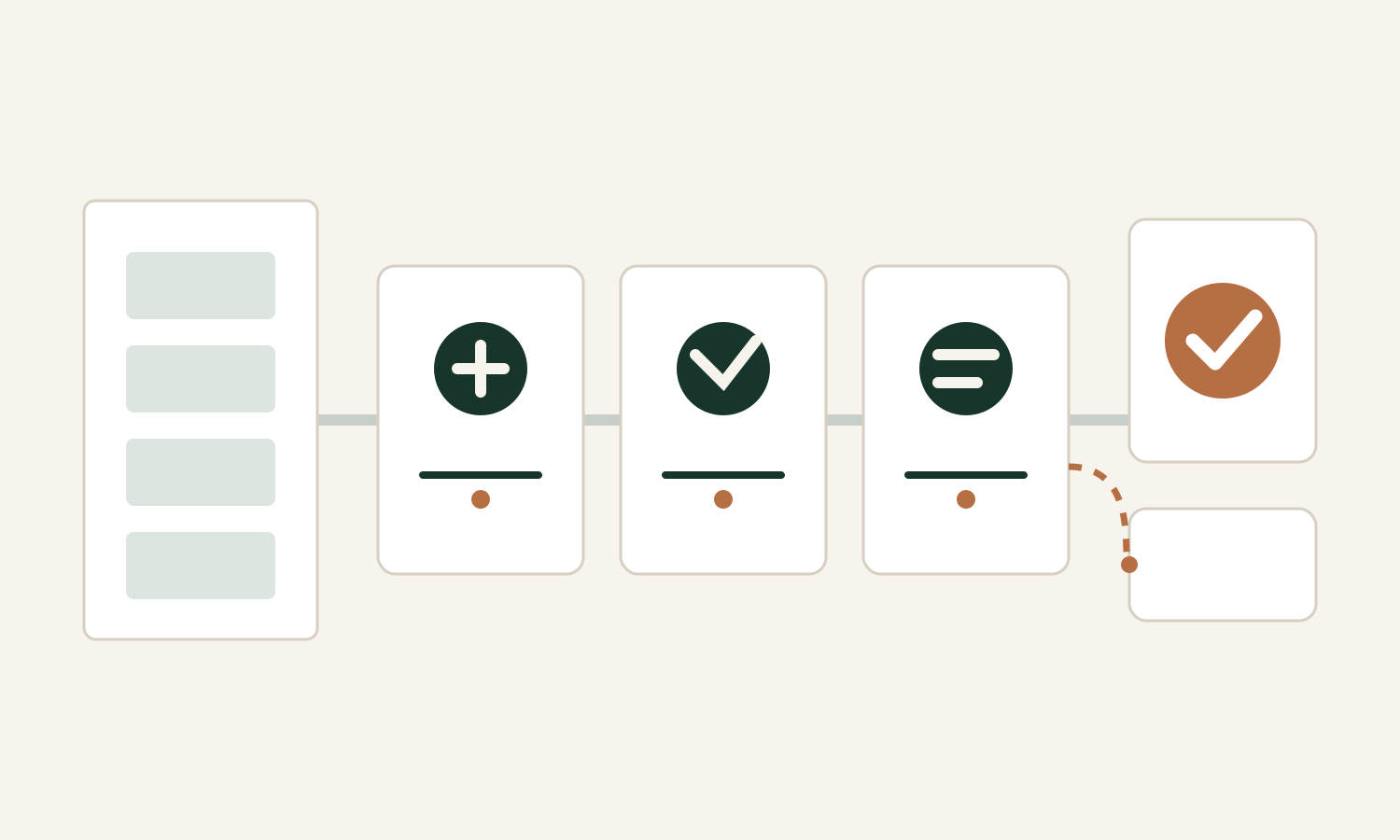
Business question: can the team turn incomplete purchasing requests into a decision-ready packet without moving approval authority?
Business question: can the team make the next safe collection action visible without losing customer context or judgment?
Business question: can a payment packet be made easier to review while bank release authority remains with an authorized person?
Start with the layer that matches your need: peer challenge, practical learning, reusable patterns, or a scoped company conversation. Each path is interest-only until its format, terms, access, or scope is confirmed.
A proposed peer working circle and purposeful founder networking for people who want to surface a recurring bottleneck, compare approaches safely, and decide whether the Club is useful.
A practical learning path for founders who need to choose useful work, frame a task, keep decision authority clear, and test the output before use.
A planned subscription layer for original FinoraAI decision briefs, task recipes, control maps, and red-team tests. Access, pricing, terms, and launch timing are confirmed before entry.
A fit conversation can determine whether a company-specific lab should be scoped. No implementation starts before written scope, permitted inputs, ownership, controls, and review terms are agreed.
Club brings the question and the peer connection around it. Academy builds the managerial skill. Library makes safe learning reusable. Company Lab is considered only after a clear problem, owner, control boundary, and written scope exist.
The planned Library is where Club questions and Academy learning become reusable FinoraAI assets. It is designed to help founders frame, inspect, and test recurring work without outsourcing their judgment or uploading confidential business information.
Define the owner, decision, evidence, friction, and result before choosing a tool or building a workflow.
Use context, sources, rules, examples, output format, review, and stop conditions to make a task inspectable.
Separate what AI may prepare from what an authorized person approves, releases, changes, or escalates.
Red-team incomplete, conflicting, duplicate, and unusual cases before any workflow is trusted with real work.
Library subscription, format, access timing, terms, and any price are confirmed before enrollment. No checkout is active on this site.
A short owner-focused feed with one Indiana development and selected AI updates. Each item links directly to its publishing organization and includes a practical action, so the news can become useful work rather than another article in the inbox.
The Indiana Economic Development Corporation’s grant announcement includes programs focused on testing AI platforms, business-specific prompts, and working outputs. Owner action: choose one recurring task and map it with fictional or non-confidential examples before testing a tool.
Read the IEDC announcement →OpenAI’s analysis describes entrepreneurs using AI to plan, start, run, and grow businesses. The transferable skill is not collecting prompts. Define one management job: a named owner, permitted non-confidential evidence, a rule, an output, human review, and a stop condition before asking AI to prepare the work.
Read OpenAI’s analysis →Anthropic announced a small-business package with connectors and ready-to-run workflows. Its examples include month-end preparation, cash planning, and invoice follow-up. Finora note: use only permitted non-confidential inputs and retain human approval before an email, publication, payment, or other external action.
Read Anthropic’s announcement →OpenAI announced the GPT-5.6 model family and describes workflows that use tools and coordinate work across steps. Owner action: define the permitted non-confidential sources, output to prepare, named reviewer, stop condition, and actions that remain human-only before testing an AI workflow.
Read OpenAI’s announcement →Sources link directly to their publishing organizations. References to third-party AI tools are descriptive only and do not imply an official relationship, certification, endorsement, or sponsorship.
These anonymized patterns show the method and type of deliverable. They are not claims about a FinoraAI client or promises of a specific financial result.
Payment and operating records from different sources were standardized, matched, and separated into explained items and exceptions requiring human review.
Local version: reconcile bank, card, booking, or field-service records without asking the team to investigate every line.
Illustrative reconciliation and finance-control workflow pattern.Operational and financial inputs were brought into a repeatable reporting flow with defined owners, checks, variance explanations, and a clear management view.
Local version: give an owner a reliable weekly view of cash, jobs, billing, collections, and issues that need attention.
Illustrative planning, liquidity, and management-reporting workflow pattern.Documents were captured, checked against business rules, routed to the right person, and retained with evidence while authorization stayed with a human.
Local version: prepare vendor bills, customer files, purchase requests, or compliance documents for faster controlled review.
Illustrative document-control, approval, and exception-design workflow pattern.FinoraAI is designed for people who bring an operating question, respect confidentiality, and can act on a decision. The aim is a clear next step: a working circle, a permission-based peer conversation, an Academy update, Library access update, or Company Lab fit conversation.
The club is not limited to finance. We focus on recurring business processes where information must be collected, checked, routed, acted on, and followed through.
You do not need an AI theatre project or a technical team. You need a real operating question, the authority to act on a better answer, and the willingness to learn from other founders without exposing confidential business data.
Show us how the work happens today, what it costs, and where the owner has lost visibility.